
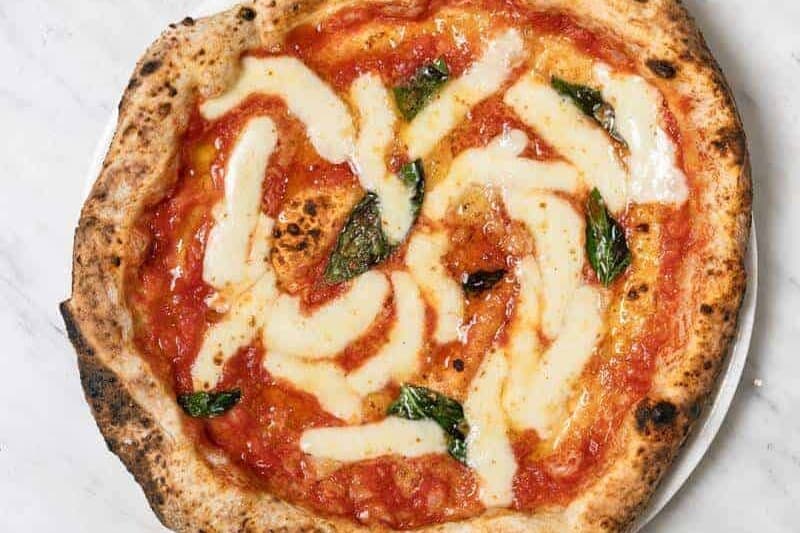
Pizza napoletana is the original.
Before wood-fired ovens became a global fashion statement, before flour obsessions took hold in food media, before pizza became a universal canvas for bold toppings and creative cross-overs — there was simply this: dough, tomato, and fire on the streets of Naples.
And after everything, it’s still perfect.
Pizza napoletana is one of the most imitated food traditions in the world, yet it remains one of the least understood outside Italy. Its simplicity isn’t a limitation — it’s the point. Its texture is precise. Its rules are deliberate. And the tradition behind it runs centuries deeper than most people realise.
At Pizza Fritta 180, understanding pizza napoletana is central to what we do — including the less-expected part of the story: its street-food sibling, pizza fritta.
What Is Pizza Napoletana?
Pizza napoletana is a style of pizza originating in Naples, in the Campania region of southern Italy. It’s characterised by a thin, soft centre, a puffy charred crust (the cornicione), and a deliberately minimal set of toppings — typically tomato, fresh cheese and basil.
What sets it apart from other pizza styles isn’t complexity. It’s discipline.
Every element — the flour, the fermentation time, the temperature, the toppings — follows a tradition refined over centuries. That tradition is now formally recognised: in 2017, UNESCO added “the art of the Neapolitan pizzaiuolo” to its Representative List of Intangible Cultural Heritage of Humanity. It’s a remarkable thing for a food to achieve, and it speaks to how seriously Naples has always taken this craft.
A Tradition Born in the Streets of Naples
Pizza has been made in Naples since at least the 18th century. The earliest versions were humble flatbreads sold cheaply on city streets — a base for whatever was available: oil, garlic, anchovies, lard. They were working food, not restaurant food.
Street Roots and Simple Ingredients
Pizzaiuoli — pizza makers — carried their wares through the city’s narrow lanes and sold them by the slice or by the fold. Eating pizza by hand, folded into a libretto (a little book), dates to this period. It wasn’t a dining experience. It was lunch.
The tradition of simplicity — a small number of ingredients, prepared with care — came directly from necessity. There was no budget for excess. What mattered was quality within constraint. That same restraint became the philosophy that defines pizza napoletana to this day.
The Margherita and the Making of an Icon
The most famous origin story in pizza belongs to 1889. Pizzaiolo Raffaele Esposito is said to have created a pizza topped with tomato, mozzarella and basil — the colours of the Italian flag — for Queen Margherita of Savoy. The pizza bore her name.
Whether every detail of the story is fully accurate is debated among food historians. What isn’t debated is the result: the Margherita became the defining reference point for pizza napoletana. Simple, balanced, honest and deeply Italian. At Pizza Fritta 180, the Margherita remains one of the most ordered pizzas on the dine-in menu — Solania San Marzano tomato, buffalo mozzarella, Pecorino Romano, Grana Padano DOP, basil and extra virgin olive oil. Nothing extraneous. Everything intentional.
What Makes Pizza Napoletana Different?
Three elements define authentic pizza napoletana, and none of them are negotiable for those who follow the tradition seriously.
The Dough: Slow-Fermented and Hand-Stretched
Traditional Neapolitan dough is made from “00” flour, water, salt and yeast — nothing else. What makes it exceptional is time. The dough ferments for a minimum of eight hours, and often significantly longer. That slow process develops flavour, digestibility and the elasticity needed for proper hand-stretching.
The dough is never rolled with a pin. Stretching by hand preserves the air pockets that puff and char in the oven, creating the cornicione’s characteristic lightness and rise.
The Oven: Wood-Fired and Intensely Hot
Pizza napoletana bakes in a wood-fired oven at temperatures between 430°C and 480°C. It cooks in just 60 to 90 seconds. That extreme heat creates the contrast the style is known for: a charred, leopard-spotted crust and a soft, yielding centre that stays moist without being underdone.
No conventional oven replicates it. Which is why even a technically identical recipe produces a different result outside a proper wood-fired environment — the heat does things to dough that time-controlled baking simply cannot.
The Toppings: Italian, Seasonal and Restrained
Pizza napoletana doesn’t pile on toppings. The philosophy is Italian minimalism at its clearest: fewer, better ingredients deliver more flavour than many mediocre ones. Each component must earn its place.
San Marzano tomatoes — grown in the volcanic soil around Mount Vesuvius — are the reference standard for the sauce. Buffalo mozzarella from Campania and fior di latte are the traditional cheeses. Basil, olive oil, and occasionally anchovies, Gaeta olives or capers complete the picture.
You’ll find those same Solania San Marzano tomatoes and Campanian cheeses across the Pizza Fritta 180 dine-in menu — across both the baked pizzas and the pizza fritta. The ingredients are the same. The cooking method is where the two traditions diverge.
The Two Classic Styles of Pizza Napoletana
In its strictest form, pizza napoletana has two defining variants — both protected by the Associazione Verace Pizza Napoletana (AVPN), the body founded in Naples in 1984 to safeguard the tradition.
Pizza Margherita
Tomato, buffalo mozzarella, basil, olive oil. The Margherita is the standard against which everything else in the Neapolitan tradition is measured. Every component is deliberate. Nothing is decorative. It remains one of the most ordered dishes at Pizza Fritta 180 — because when the ingredients are right, nothing needs to be added.
Pizza Marinara
Tomato, garlic, oregano, olive oil — no cheese at all. The Marinara is the older of the two classic styles, named not for the sea but for the mariners’ wives who traditionally prepared it before long voyages. It’s more pungent, more austere, and in some ways the purest expression of what pizza napoletana was designed to be before it became a global icon.
The spirit of the Marinara lives on at Pizza Fritta 180 in the UNESCO pizza — a deliberate nod to the cultural heritage, featuring San Marzano, garlic, oregano, basil and extra virgin olive oil. The name is earned.
UNESCO Recognition and What It Actually Means
In 2017, UNESCO’s inscription of “the art of the Neapolitan pizzaiuolo” recognised something specific: not a recipe, but a practice. A skill. The way knowledge passes from master to apprentice through touch, instinct and repetition — how a pizzaiolo reads the dough, reads the oven, and makes decisions that no recipe can fully describe.
The inscription named this as a living tradition central to the cultural identity of Naples.
It didn’t change how the pizza was made. It confirmed that the way it had always been made was worth protecting — and that the people who make it are custodians of something genuinely irreplaceable.
Pizza Fritta: The Other Side of the Neapolitan Tradition
Pizza napoletana and pizza fritta share a city, a culture and the same dough tradition. But they represent two very different moments in Neapolitan life.
Where pizza napoletana is baked flat and open — toppings visible, crust charring in an 480°C oven — pizza fritta is sealed and submerged in hot oil. Where baked pizza is laid out on a platter, pizza fritta is torn open by hand at the table, its filling released in a rush of steam. One belongs to the dining room. The other belongs to the street corner.
Both are Neapolitan. Both come from the same philosophy: dough made with care, ingredients chosen honestly, food eaten with pleasure and without pretension.
If pizza napoletana is the formal heritage, pizza fritta is its working-class sibling — the dish that kept Naples fed when ovens were too expensive to fuel and flour was rationed. Read more about what pizza fritta is and where it comes from — and why the two traditions are inseparable parts of the same story.
Pizza Napoletana in Sydney
Sydney has developed a genuine appetite for Neapolitan pizza over the past decade — one that’s shifted from novelty to expectation. Diners here increasingly understand the difference between a pizza that performs the tradition and one that’s actually rooted in it.
In Surry Hills, Pizza Fritta 180 brings both sides of Naples to one address on Crown Street: baked Neapolitan pizzas made with San Marzano tomatoes and Campanian cheeses, alongside the pizza fritta that gives the venue its name and its purpose.
The approach is consistent across the menu — quality ingredients, Neapolitan method, nothing unnecessary. Discover why pizza fritta has found such a passionate following in Sydney, and how it fits naturally alongside the baked tradition it grew up beside.
👉 Reserve a table and explore the full Neapolitan menu at Pizza Fritta 180 in Surry Hills
Frequently Asked Questions
Pizza napoletana is a traditional style of pizza originating in Naples, Italy. It’s made with slow-fermented dough, hand-stretched and cooked in a wood-fired oven at extreme heat, and topped with simple, high-quality Italian ingredients — typically San Marzano tomato, buffalo mozzarella and basil. The tradition is formally recognised by UNESCO as intangible cultural heritage.
Pizza napoletana is defined by its slow-fermented, hand-stretched dough; its extremely hot wood-fired oven (430–480°C); and its minimal, carefully sourced toppings. The result is a thin, soft centre with a puffy, charred crust — quite different from the denser bases of Roman, New York or American-style pizza.
The two classic and officially protected styles are the Pizza Margherita (tomato, buffalo mozzarella, basil, olive oil) and the Pizza Marinara (tomato, garlic, oregano, olive oil — no cheese). Both are protected by the Associazione Verace Pizza Napoletana (AVPN).
In 2017, UNESCO added “the art of the Neapolitan pizzaiuolo” to its Representative List of Intangible Cultural Heritage of Humanity. The recognition honoured the skill and craft of Neapolitan pizza makers — specifically the knowledge passed through generations by touch, instinct and repetition — as a living tradition central to the cultural identity of Naples.
Both traditions originate in Naples and use the same dough. Pizza napoletana is baked in a wood-fired oven; pizza fritta is flash-fried in oil. Pizza fritta emerged as the street-food alternative when ovens were inaccessible or expensive — the two are different expressions of the same Neapolitan culinary culture, made from the same foundations.
Traditional pizza napoletana dough is made with “00” flour — a finely milled Italian wheat flour with a specific protein level that gives the dough its elasticity, lightness and capacity for long, slow fermentation.