
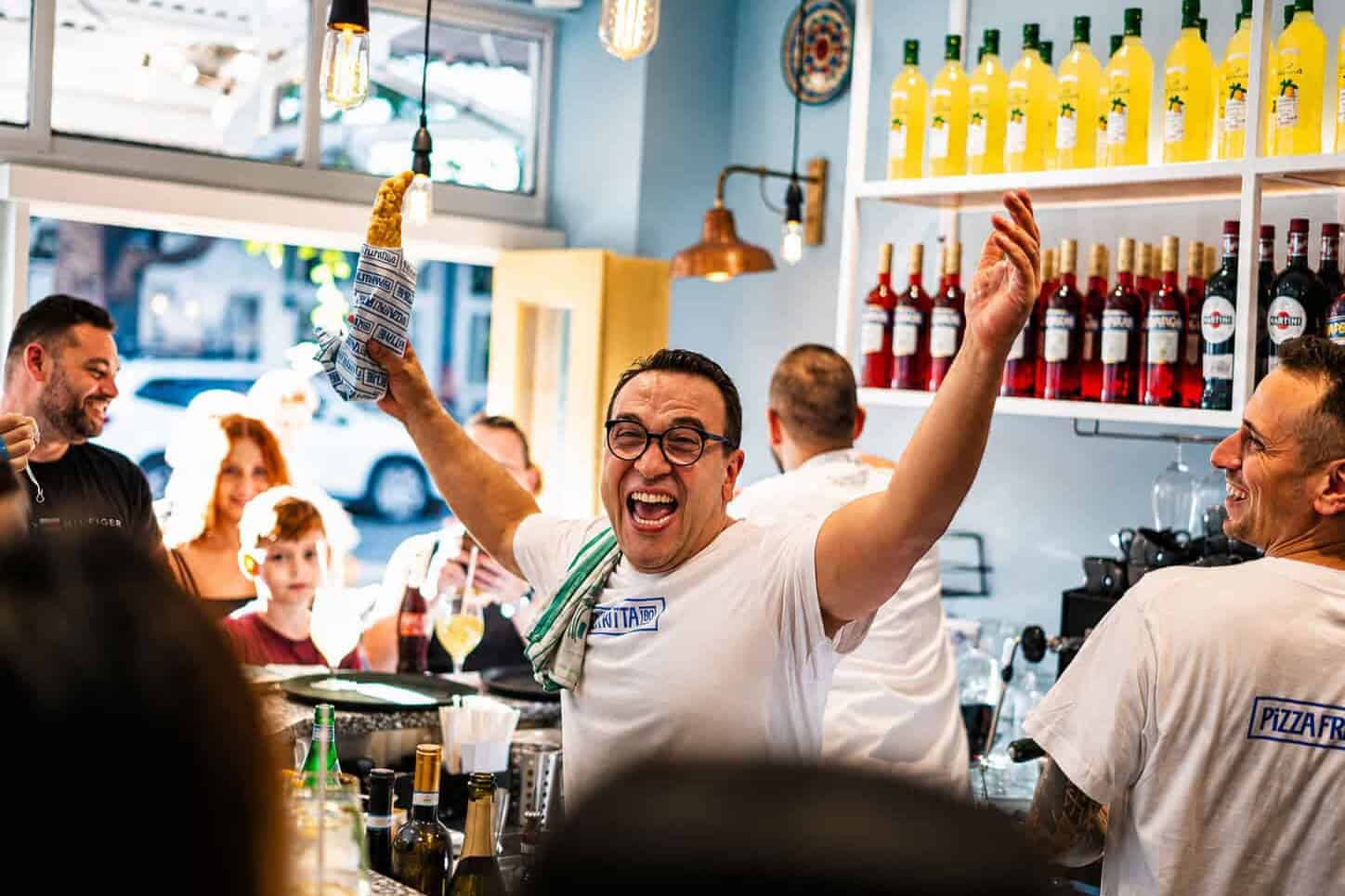
Pizza fritta has been feeding Neapolitans for over a century. At Pizza Fritta 180, Sydney’s Home of Neapolitan Pizza Fritta, it’s been doing the same since 2020 — and most first-timers walk away asking the same thing: why did it take this long to get here?
The answer to why pizza fritta is so popular isn’t a single thing. It’s heritage, texture, portability, and something harder to name — the feeling of eating food that has been made exactly right, exactly the way it’s always been made.
Born From Necessity, Perfected Over Generations
Pizza fritta became a staple of Neapolitan life during and after World War II, when wood for ovens was scarce and many traditional pizza ingredients had become too expensive to source. The practical solution was to fry the dough in oil instead — fast, affordable, and requiring almost nothing beyond a pot and heat.
What started as a workaround quickly became something that outlasted the necessity. The technique — sealing the dough in hot oil at around 180°C — produced a result that a wood-fired oven simply couldn’t replicate. The high-temperature fry locked in steam, keeping the interior soft and airy while the exterior turned golden and crisp in seconds. It wasn’t a cheaper substitute for baked pizza. It was a different dish entirely.
Naples kept making pizza fritta long after other options returned. It was never a stopgap. It was a tradition — and traditions with this much flavour rarely disappear.
The Texture Is the Whole Point
Pizza fritta’s popularity comes down to a textural contrast that baked pizza cannot offer: a shell that gives when you press it, and a centre that’s still soft and steaming within.
Tear one open at the table and the experience is immediate. The exterior yields — lightly, satisfyingly — and warm steam escapes from a soft interior. The filling, whether molten fior di latte or ricotta pressed through with cured meat, collapses into the dough. It’s closer to a perfectly made arancini than anything from a wood-fired oven: intimate, immediate, and still warm all the way through.
That contrast doesn’t wear off. It’s the reason people come back.
Built for the Street, Not the Table
Pizza fritta was designed for the street — and that informality is a feature, not a limitation.
In Naples, vendors carried trays of freshly fried pizza through neighbourhoods, selling from doorways and calling up to apartment balconies. Friends grabbed one late at night on the way home. It was wrapped in paper, eaten standing, held in one hand. The food and the city were physically intertwined — one flowing through the streets of the other.
That street-food tradition is still present in every serve. Paper wrapping, eaten hot, immediate: casual by design, made with precision.
Fried, Not Heavy — The Surprising Truth
Pizza fritta is not greasy when it’s made correctly, and most first-timers are surprised by how balanced it feels.
The key is temperature. At exactly 180°C — the number that gives Pizza Fritta 180 its name — the dough seals almost instantly when it hits the oil, preventing absorption into the interior. What you get is a crust that’s crisp rather than oily, with an interior that’s light and airy rather than dense. That standard isn’t a marketing number; it’s the precise temperature at which the physics of the dish work correctly.
Third-generation Neapolitan pizzaiolo Luigi Esposito built Pizza Fritta 180, a Neapolitan pizza fritta restaurant in Surry Hills, Sydney, around that standard. The name is the proof. Get the temperature right and you get a dish that’s indulgent in the best sense — satisfying, not heavy.
Why pizza fritta is lighter than it looks →
Why Nothing Else in Sydney Compares
Pizza fritta occupies a category of its own — sealed and filled rather than open-faced, crisp-shelled rather than chewy-based, eaten whole with your hands rather than cut into slices. Sydney has excellent baked pizza: Via Napoli‘s wood-fired Neapolitan and 170 Grammi‘s Roman-style bases, both built by the same Luigi Esposito-led team, prove that on their own. That was never the argument.
The flavours are familiar: tomato, mozzarella, ricotta, salami. What’s unfamiliar is everything else — the format, the texture, the way you eat it. That combination of recognisable and new is what makes the dish exciting. And it isn’t a novelty. It’s a parallel tradition that predates most of what Australians think of as Italian food, and it’s been waiting here, largely undiscovered, until now.
It Was Made for Sharing
Pizza fritta doesn’t really work as a solitary meal — or rather, it’s considerably better when it isn’t one.
Order a mix of fillings, tear them open at the table, pass pieces around, and the meal finds its own rhythm: relaxed, communal, and naturally a little celebratory. The format lends itself to this. A sealed golden pocket pulled apart and shared is an inherently generous way to eat. One fritta becomes several, and several becomes a proper evening out — the kind that lingers over the table rather than rushing to the end.
The Cultural Weight Behind the Dish
Pizza fritta carries more cultural history than most food has any right to hold. It became internationally known in part through cinema: in Vittorio De Sica’s L’oro di Napoli (The Gold of Naples, 1954), a young Sophia Loren plays a street vendor selling pizza fritta from a tray — joyful, unapologetic, completely at ease with what she’s doing. That image has stayed in the cultural memory for over seventy years.
It resonated because it captured something true. Pizza fritta is not a refined interpretation of street food. It is street food — honest, specific, and made with the kind of craft that doesn’t need to announce itself. The dish outlasted everything that surrounded it in post-war Naples and continues to be made the same way today.
Why Sydney Is Ready for It Now
Pizza fritta fits something that’s shifted in Sydney’s food culture — a growing appetite for restaurants with genuine history behind them, food with a clear point of view and a technique worth taking seriously.
Surry Hills, in particular, has the right conditions: food-literate diners, independent venues with strong identities, and a neighbourhood culture that responds to specificity over novelty. A restaurant built entirely around one historic Neapolitan dish — and named after the exact temperature at which it’s made — fits naturally into that context.
Sydney didn’t warm to pizza fritta simply because it’s good. It warmed to it because it has a genuine reason for being exactly what it is.
So why is pizza fritta so popular? Because it delivers on every level at once — heritage, texture, portability, comfort, and a social quality that turns a meal into something worth lingering over. Nostalgic without feeling dated. Indulgent without being excessive. Specific enough to be impossible to mistake for anything else.
Once you’ve had it made properly — shell cracking open, steam rising, filling still molten — the question answers itself.
Book a table at Pizza Fritta 180, Crown Street Surry Hills →
Frequently Asked Questions
Why is pizza fritta so popular in Naples?
Pizza fritta became popular in Naples during and after World War II, when wood for ovens was scarce and traditional pizza ingredients were too expensive to source. Frying dough in oil was fast, affordable, and needed almost no equipment. The tradition outlasted the shortage because the result was worth keeping — vendors sold it from doorways and balconies, and it became a fixture of everyday Neapolitan street life that never fell out of favour.
Is pizza fritta just deep-fried pizza?
Pizza fritta is not a fried version of baked pizza — it is a distinct Neapolitan tradition. Dough is sealed, usually folded around a filling, then flash-fried at high temperature to produce a crisp golden exterior and a soft, steamy interior. The format, technique, and eating experience are fundamentally different from baked pizza, which is open-faced and oven-cooked. Pizza fritta has its own history and its own category.
Is pizza fritta greasy or heavy?
Pizza fritta is surprisingly light when made at the correct temperature. At 180°C — the standard used at Pizza Fritta 180 in Surry Hills — the dough seals almost instantly when it hits the oil, which stops it absorbing into the interior. The result is a crust that’s crisp rather than oily, with an interior that stays soft and airy rather than dense. Most first-timers are surprised by how balanced it feels.
What makes pizza fritta different from baked Neapolitan pizza?
Pizza fritta and baked Neapolitan pizza share a cultural origin but are different dishes. Pizza fritta is sealed — dough shaped around a filling and cooked in oil — producing a crisp shell with a soft, steamy interior and the filling enclosed inside. Baked Neapolitan pizza is open-faced, topped and cooked in a wood-fired oven, producing a chewy base with charred edges. The two formats, textures, and histories are distinct.
Is pizza fritta meant to be shared?
Pizza fritta works best as a shared meal. Ordering a mix of fillings, tearing them open at the table, and passing pieces around is the most natural way to eat it — relaxed, communal, and a little celebratory. A sealed golden pocket pulled apart is an inherently generous way to eat. At Pizza Fritta 180 in Surry Hills, set menus are available for groups who want to work through a range of fillings together.