
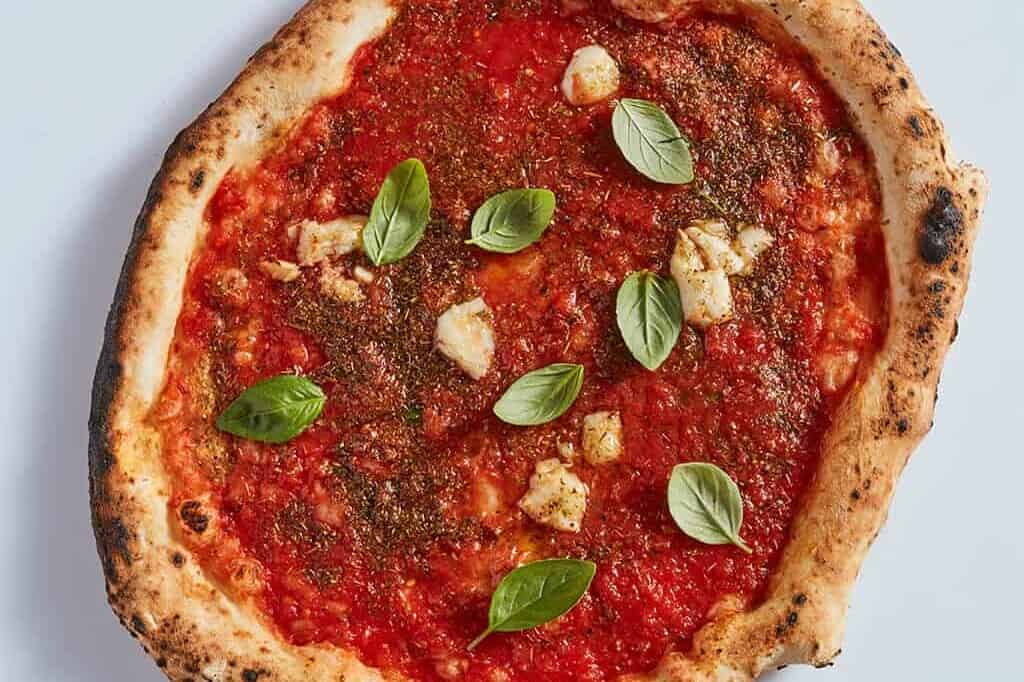
Ask any serious Neapolitan pizzaiolo which ingredient they’d be least willing to compromise on and you’ll get the same answer, delivered without hesitation.
The tomato.
Not the cheese, not the flour, not even the oven. The tomato. Specifically: the San Marzano tomato, grown in a narrow stretch of volcanic soil south of Naples, protected by Italian law, and responsible — more than any other single ingredient — for the flavour profile that defines Neapolitan pizza the world over.
At Pizza Fritta 180, Solania San Marzano tomatoes appear on every pizza that calls for a tomato base. That choice isn’t decorative. It’s the same choice Neapolitan kitchens have been making for generations, and the reasons behind it run deeper than most people realise.
A Tomato With a Very Specific Address
The San Marzano tomato takes its name from San Marzano sul Sarno, a small town in the Agro Sarnese-Nocerino plain in Campania — the same southern Italian region that gave the world pizza napoletana, buffalo mozzarella and limoncello. It’s a place of considerable agricultural heritage, and the San Marzano tomato is arguably its most important export.
What makes this particular patch of earth so significant is what lies beneath it. The Agro Sarnese-Nocerino plain sits in the shadow of Mount Vesuvius, and the soil here has been shaped by centuries of volcanic activity. Rich in minerals, well-draining and uniquely fertile, it creates growing conditions that produce tomatoes with characteristics you simply cannot replicate by planting the same variety elsewhere.
Growers have tried. The results are consistently, measurably inferior.
What Makes San Marzano Tomatoes Different?
The San Marzano variety is a plum tomato — elongated, meaty and thin-skinned. But the geography does things to it that genetics alone cannot.
Lower Acidity, Higher Natural Sweetness
San Marzano tomatoes are notably less acidic than most tinned tomato alternatives. That lower acidity is one of the most important qualities for pizza: it means the tomato sauce doesn’t fight the cheese, doesn’t overwhelm the dough, and doesn’t require sugar or other additions to balance it. The sweetness is already there, naturally, from the soil and the growing conditions.
On a Margherita pizza — where tomato, cheese and basil are the only flavours — this matters enormously. There’s nowhere for a harsh, acidic tomato to hide.
Dense Flesh, Minimal Seeds
San Marzano tomatoes have thick, dense flesh and relatively few seeds compared to round varieties. Less water content means a more concentrated flavour and a sauce that doesn’t make the pizza base soggy. The structural integrity of the flesh also means it holds up well through processing and canning — arriving in a tin in much the same condition it left the field.
A Flavour You Can Taste Without Cooking
Open a tin of genuine DOP San Marzano tomatoes and taste one straight from the can. The flavour is immediate — bright, balanced, complex in a way that is difficult to describe without tasting it. There’s depth there that supermarket alternatives, however ripe and red they appear, don’t quite match. Cooking concentrates it further, but the raw product already tells the story.
DOP: What the Certification Actually Means
DOP — Denominazione di Origine Protetta, or Protected Designation of Origin — is the Italian (and broader European) system for protecting agricultural products whose quality and characteristics are fundamentally tied to their place of origin. It’s the same certification that protects Parmigiano Reggiano, Prosciutto di Parma and buffalo mozzarella from Campania.
For San Marzano tomatoes, DOP status means three things above everything else: the tomatoes must be grown in the designated geographic zone, from the approved San Marzano variety, and processed according to strictly defined methods. Peeled whole, packed in their own juice, with minimal other ingredients permitted. No tomato concentrate. No artificial flavouring. Nothing that obscures what the tomato actually tastes like.
San Marzano vs. “San Marzano-Style”
This is where it gets important for anyone buying tomatoes to cook with. The San Marzano name is not legally protected outside of Italy in the same way, which means tins labelled “San Marzano-style” or simply “San Marzano” without the DOP mark may contain tomatoes grown anywhere — including California, China or the Netherlands — in the San Marzano variety, or a similar one, but without the Campanian soil conditions that make the original what it is.
The DOP mark on the tin is the only guarantee of the real thing. Everything else is an approximation.
Why Neapolitan Pizza Tradition Is Built Around This Tomato
The Associazione Verace Pizza Napoletana — the body founded in Naples in 1984 to protect and define authentic Neapolitan pizza — specifies San Marzano DOP tomatoes as the standard for Neapolitan tomato sauce. This isn’t a recommendation. It’s a definition. You cannot call a pizza “verace napoletana” and use something else.
That strictness reflects a broader principle: in Neapolitan cooking, quality of ingredients is the technique. You don’t compensate for inferior tomatoes with skill. You source better tomatoes.
The Margherita as the Test
The clearest proof of this philosophy is the Margherita. Three ingredients: tomato, mozzarella, basil. No sauce to cook off the harshness, no abundance of toppings to create complexity through combination. The tomato has to carry its weight alone, and a San Marzano tomato is the one ingredient capable of doing it.
The pizza napoletana tradition has always understood this. The simplicity of the great Neapolitan pizzas isn’t a limitation — it’s a framework that forces ingredient quality to the foreground. San Marzano tomatoes exist at the centre of that framework because nothing else belongs there.
Solania: The Grower Behind the Tomato
Solania is one of the most respected producers of San Marzano DOP tomatoes in Italy — a family-owned operation in Campania that has been growing and processing San Marzano tomatoes for decades. Their product is the benchmark used by some of the most serious Neapolitan pizzerias both in Italy and internationally, and it’s the brand that appears on every tomato-based pizza at Pizza Fritta 180.
What distinguishes Solania isn’t simply the DOP certification, though that matters. It’s the consistency of the product across tins and across seasons, and the processing method that preserves the raw flavour of the tomato rather than cooking it into something more neutral. When you taste a Solania San Marzano tomato, you’re tasting a growing tradition as much as you’re tasting a piece of fruit.
San Marzano Tomatoes at Pizza Fritta 180
On the Pizza Fritta 180 dine-in menu, Solania San Marzano tomatoes form the base of every pizza that uses a tomato sauce — the Margherita, the UNESCO, and the broader range of baked Neapolitan pizzas. They’re used simply: lightly crushed or passed, seasoned, applied without heavy cooking. The goal is to let the tomato taste like itself rather than to transform it into something else.
This approach — minimal intervention with exceptional ingredients — is the same one that defines the dough, the cheese and every other element of the menu. It’s a philosophy that runs through the Neapolitan tradition from the 18th century to the present, and it’s as coherent now as it ever was.
Understanding the San Marzano tomato is one way of understanding what makes Neapolitan pizza distinct: not technique for its own sake, not complexity for its own sake, but the disciplined commitment to ingredients that are already extraordinary before they reach the kitchen.
The best argument for the San Marzano tomato isn’t a description. It’s a Margherita.
👉 Reserve a table at Pizza Fritta 180 and taste what a great tomato actually does to a pizza
Frequently Asked Questions
San Marzano tomatoes are a variety of plum tomato grown in the Agro Sarnese-Nocerino plain near Naples, in the volcanic soil of the Campania region of southern Italy. They are prized for their lower acidity, natural sweetness, dense flesh and complex flavour — qualities shaped by the specific soil and climate of their growing area.
The Associazione Verace Pizza Napoletana specifies San Marzano DOP tomatoes as the standard for authentic Neapolitan pizza sauce. Their lower acidity and natural sweetness mean they don’t require additives to balance, their dense flesh doesn’t add excess moisture, and their flavour is complex enough to hold up on a simple pizza like a Margherita without additional help from other ingredients.
DOP (Denominazione di Origine Protetta) is a European protected designation of origin that guarantees the tomatoes were grown in the designated geographic area in Campania, from the approved San Marzano variety, and processed according to specific methods. It’s the only reliable way to confirm you’re getting the genuine product rather than a San Marzano-style imitation.
San Marzano DOP tomatoes are lower in acidity, sweeter, meatier and more complex in flavour than most standard tinned tomatoes. The difference comes from the volcanic soil of Campania and the specific growing conditions of the San Marzano region — conditions that cannot be replicated by planting the same variety in a different location.
Solania is a respected Campanian producer of San Marzano DOP tomatoes, used by many of the most serious Neapolitan pizzerias in Italy and internationally. Their tomatoes are benchmarked for consistency and flavour integrity — and are the San Marzano tomatoes used at Pizza Fritta 180.
Yes — their lower acidity and higher natural sugar content (a result of the volcanic soil and growing conditions) give San Marzano tomatoes a noticeably sweeter flavour profile compared to most tinned tomato alternatives. This sweetness requires no added sugar to balance, which is why they work so well on a simple, unadorned Neapolitan pizza base.
Solania San Marzano DOP tomatoes are used across the pizza menu at Pizza Fritta 180 in Surry Hills, Sydney — including on the Margherita and other Neapolitan-style baked pizzas. The best way to taste what they do is to order a Margherita: three ingredients, nothing hidden, the tomato doing exactly what it’s there to do.