
The most important ingredient in Neapolitan pizza is also the one that receives the least attention from the people eating it. It doesn’t appear in the name of the dish. It isn’t sourced from a protected region or listed on the menu with a producer credit. It’s largely invisible on the plate.
But without it, nothing else works.
The dough is the foundation of everything in the Neapolitan tradition — the thing that determines whether a pizza has genuine depth of flavour or merely looks the part, whether it leaves you feeling light or heavy, whether the crust has character or just colour. Understanding what Neapolitan pizza dough actually is, and what fermentation does to it, is one of the most direct paths to understanding why some pizzas are so much better than others.
At Pizza Fritta 180, the same dough philosophy underpins both the baked Neapolitan pizzas and the pizza fritta the venue is named for. The method changes. The dough does not.
Four Ingredients, Extraordinary Results
Traditional Neapolitan pizza dough contains exactly four things: flour, water, salt, and yeast. No oil. No sugar. No improvers or additives. The Associazione Verace Pizza Napoletana — the body that has formally defined authentic Neapolitan pizza since 1984 — is explicit about this. The simplicity is not accidental; it is the point.
What transforms these four basic ingredients into something with real complexity is time. Specifically, the time the dough is allowed to ferment before it’s shaped and cooked. That fermentation is where the flavour, the texture, and the digestibility of a great Neapolitan pizza are actually built.
The Role of “00” Flour
“00” flour is the Italian classification for finely milled wheat flour — a designation that refers to how finely the grain has been ground rather than its protein content, though the two are related. The finest 00 flours used for Neapolitan pizza have a specific protein level (typically around 11–12.5%) that gives the dough its characteristic elasticity and extensibility.
That balance matters enormously. Too little protein and the dough tears when stretched; too much and it becomes tight and resistant, pulling back into itself rather than opening out smoothly under the pizzaiolo’s hands. The right 00 flour sits in the range where the dough can be stretched to almost translucent thinness without breaking — which is what allows the centre of a Neapolitan pizza to be as thin and yielding as it is, while the cornicione (the raised crust edge) puffs and chars in the oven.
It’s also a flour that responds exceptionally well to long, slow fermentation — developing flavour and structure in a way that faster, weaker flours simply cannot match.
What Fermentation Actually Does
Fermentation is often spoken about in vague, slightly mystical terms. But what’s happening in a ball of Neapolitan dough over twelve, twenty-four or forty-eight hours is quite specific, and the effects on the final pizza are real and measurable.
Flavour Development
As yeast consumes the sugars in the flour, it produces carbon dioxide (which makes the dough rise) and a range of organic acids and aromatic compounds. These acids — primarily lactic and acetic — are what give well-fermented Neapolitan dough its subtle complexity: a slight tang, a depth that plain dough doesn’t have, and a flavour that persists even after the crust has been through a 480°C wood-fired oven.
A dough fermented for six hours has some of this. A dough fermented for 48 or 72 hours has considerably more. This is why Neapolitan pizzerias that take the craft seriously think in terms of days rather than hours — and why the difference in flavour between a rushed dough and a properly rested one is immediately apparent to anyone who eats both.
Gluten Development and Texture
The extended fermentation also changes how the gluten in the dough behaves. Gluten — the protein network that forms when flour and water are combined and worked — tightens naturally during mixing and in the early stages of fermentation. Left to rest for long enough, it relaxes. The dough becomes extensible and supple rather than resistant and springy.
This relaxed gluten structure is what makes hand-stretching a Neapolitan dough possible. A well-fermented ball of dough opens almost effortlessly under trained hands, spreading wide and thin without tearing. A under-fermented or over-worked dough fights back — contracting as soon as you try to stretch it, stubbornly resisting the shape you’re trying to create.
Digestibility
This is a benefit that rarely appears on menus but is consistently noted by people who eat well-made Neapolitan pizza regularly. Long fermentation partly breaks down the complex starches and some of the gluten in the flour, making the finished pizza significantly easier for the body to process than bread made quickly.
It’s a meaningful distinction. Pizza made with properly fermented dough tends not to leave you feeling bloated or heavy — a common complaint about lesser versions. This isn’t a health claim in any formal sense; it’s a practical observation that lines up with the food chemistry of what long fermentation actually does to a dough.
Cold Fermentation vs Ambient Fermentation
There are two primary approaches to fermenting Neapolitan dough: leaving it at room temperature (ambient fermentation) or resting it in a refrigerator (cold fermentation). Both are legitimate within the tradition, and both produce good results when managed correctly. The key difference is time and control.
Ambient fermentation at around 18–22°C typically runs between 8 and 24 hours. The yeast is more active, fermentation moves faster, and the dough needs closer attention — the window between perfectly fermented and over-fermented can be narrow, especially in a warmer environment.
Cold fermentation, where the dough rests at refrigerator temperature (typically 2–4°C), can run for 24 to 72 hours or even longer. The slow, cool environment causes fermentation to proceed very slowly, which gives the dough more time to develop flavour while producing a dough that is easier to manage and more consistent in its behaviour at the bench.
Many serious Neapolitan pizzerias — including those operating in Australia, where ambient temperatures can be high — favour cold fermentation for its reliability and the particular depth of flavour a long, cold rest produces. The approach at Pizza Fritta 180’s Neapolitan tradition follows this same discipline: time is treated as an ingredient, not as something to be minimised.
Why Neapolitan Dough Is Never Rolled
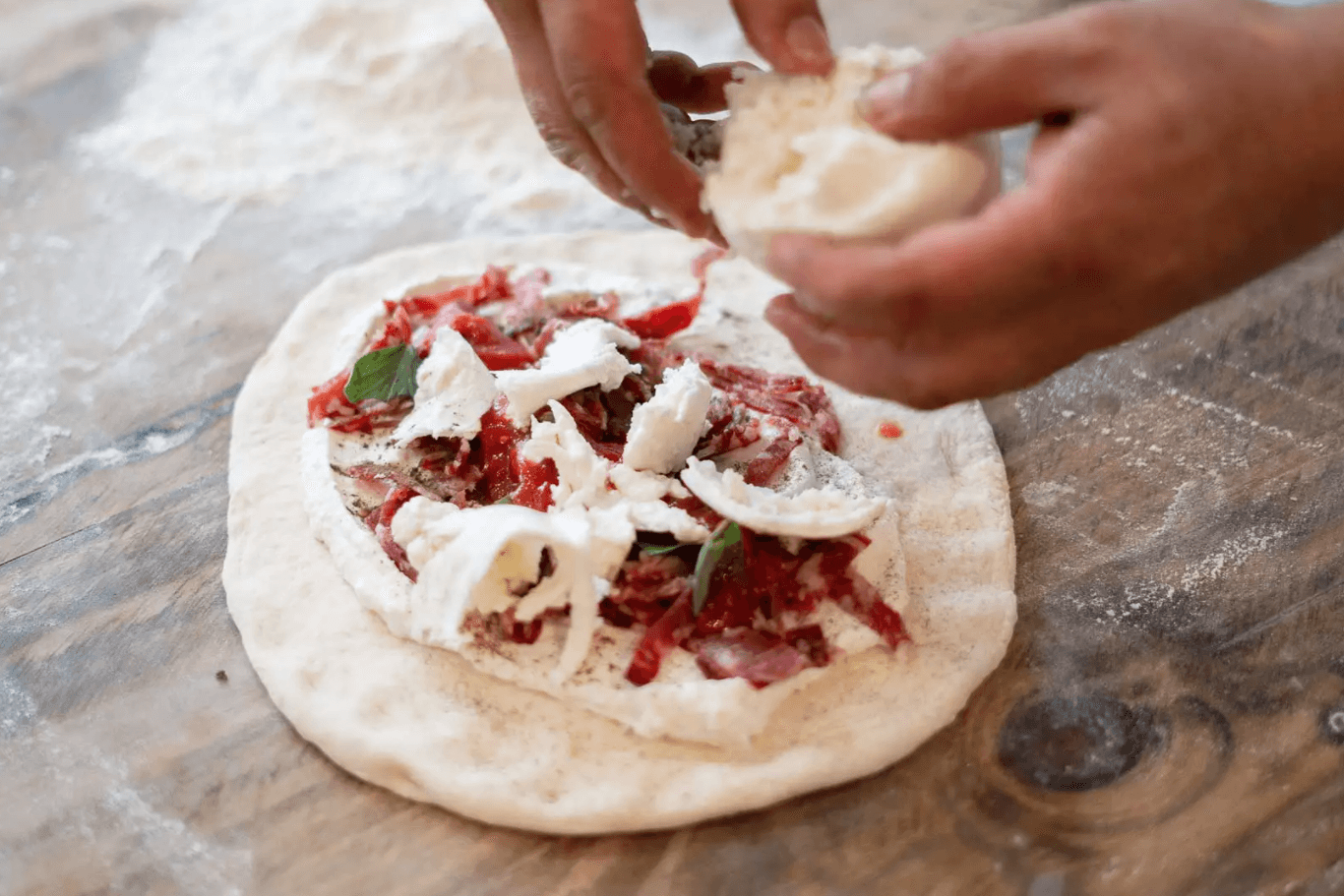
One of the clearest markers of a pizza made with genuine Neapolitan intention is the absence of a rolling pin. Neapolitan dough is always opened by hand — pressed from the centre outward, then lifted and rotated, stretched by gravity and the pressure of the fingers and knuckles until it reaches the right diameter and thickness.
This matters for a precise reason: rolling compresses the air pockets that have built up in the dough during fermentation. Those pockets are where the cornicione gets its lift and lightness in the oven — where the crust puffs, chars in leopard spots, and develops its characteristic combination of crisp exterior and airy crumb. Roll the dough flat and you crush those pockets before they’ve had the chance to do anything.
Hand-stretching requires a dough that’s relaxed and extensible — which circles back to fermentation. The dough has to have rested long enough, and the gluten has to have relaxed sufficiently, for the hand-stretch to work without the dough fighting back. A rushed dough that hasn’t fermented properly is almost impossible to stretch by hand without tearing. A dough given the time it needs opens almost as if it wants to.
The Same Dough, Two Cooking Methods
At Pizza Fritta 180, the dough used for the baked Neapolitan pizzas and the pizza fritta shares the same foundation: the same flour, the same fermentation philosophy, the same hand-stretching approach. What changes is everything that happens after the dough is shaped.
In the wood-fired oven, the stretched dough is topped and cooked at extreme heat — typically around 430–480°C for sixty to ninety seconds. That intense, dry heat creates the characteristic contrast of baked Neapolitan pizza: a soft, yielding centre and a crust with char, lift, and complexity.
For pizza fritta, the dough is sealed rather than topped — folded or formed around the filling — and lowered into oil at 180°C, where it cooks rapidly from the outside in. The frying creates its own kind of contrast: a crisp, golden shell and a steamy, airy interior. The principles of good dough still apply — proper fermentation, relaxed gluten, appropriate hydration — but the cooking environment changes how those qualities express themselves entirely.
Understanding this is part of understanding why the dough is so central to the Neapolitan tradition. It’s not just a base or a vessel. It’s the thing that makes both styles of pizza possible, and the thing that makes both of them, when done right, genuinely extraordinary.
👉 Reserve a table at Pizza Fritta 180 — and taste what properly fermented Neapolitan dough actually feels like.
Frequently Asked Questions
Neapolitan pizza dough is made from just four ingredients — “00” flour, water, salt, and yeast — and relies on long fermentation (typically 24–72 hours) to develop flavour, texture, and digestibility. It uses no oil, sugar, or additives, and is always stretched by hand rather than rolled. The result is a dough with genuine complexity: slightly tangy, extensible, and light in a way that fast-made alternatives rarely achieve.
“00” is the Italian classification for very finely milled wheat flour. For Neapolitan pizza, flours with a specific protein level (around 11–12.5%) are selected — high enough to develop good gluten structure and elasticity, low enough to remain extensible and supple after fermentation. This combination is what allows the dough to be stretched by hand to the right thinness and to puff correctly in an extremely hot oven.
The Associazione Verace Pizza Napoletana specifies a minimum of eight hours, but serious Neapolitan pizzerias typically ferment their dough for significantly longer — often 24 to 72 hours, and sometimes more. The longer the fermentation, the more developed the flavour, the more relaxed the gluten structure, and the easier the dough is to handle and shape. Cold fermentation (at refrigerator temperature) is often used for longer rests, as it slows the process and improves consistency.
Rolling compresses the air pockets that develop in the dough during fermentation. Those pockets are what give the cornicione (the raised crust edge) its lift, lightness and characteristic airy crumb when it hits the heat of a wood-fired oven. Hand-stretching preserves those pockets, opening the dough from the centre outward without degassing it. A well-fermented dough stretches almost effortlessly; a rushed one tears or pulls back.
Long fermentation partly breaks down complex starches and some of the gluten in the flour, which does appear to make the finished pizza easier on the digestive system than bread produced quickly. Many people who find commercial pizza heavy or bloating notice no such effect with well-made, long-fermented Neapolitan dough. This is a practical observation rather than a formal health claim, but it’s one that lines up with the food chemistry of extended fermentation.
Yes. At Pizza Fritta 180, the same fundamental dough — made with “00” flour, fermented slowly, and stretched by hand — is used for both baked Neapolitan pizzas and pizza fritta. The dough is then formed differently (flat and open-topped for the oven; sealed and folded for frying) and cooked in entirely different environments. The same quality of dough expresses itself differently through each method.
The cornicione is the raised, puffed crust edge of a Neapolitan pizza — the part that chars in a wood-fired oven and provides the structural frame around the centre. A well-made cornicione is light and airy inside, with a slightly crisp exterior and characteristic dark spots (called leopard spotting) from the intense heat. It’s formed by the air pockets preserved during hand-stretching and the extreme oven temperature that causes them to expand rapidly.