
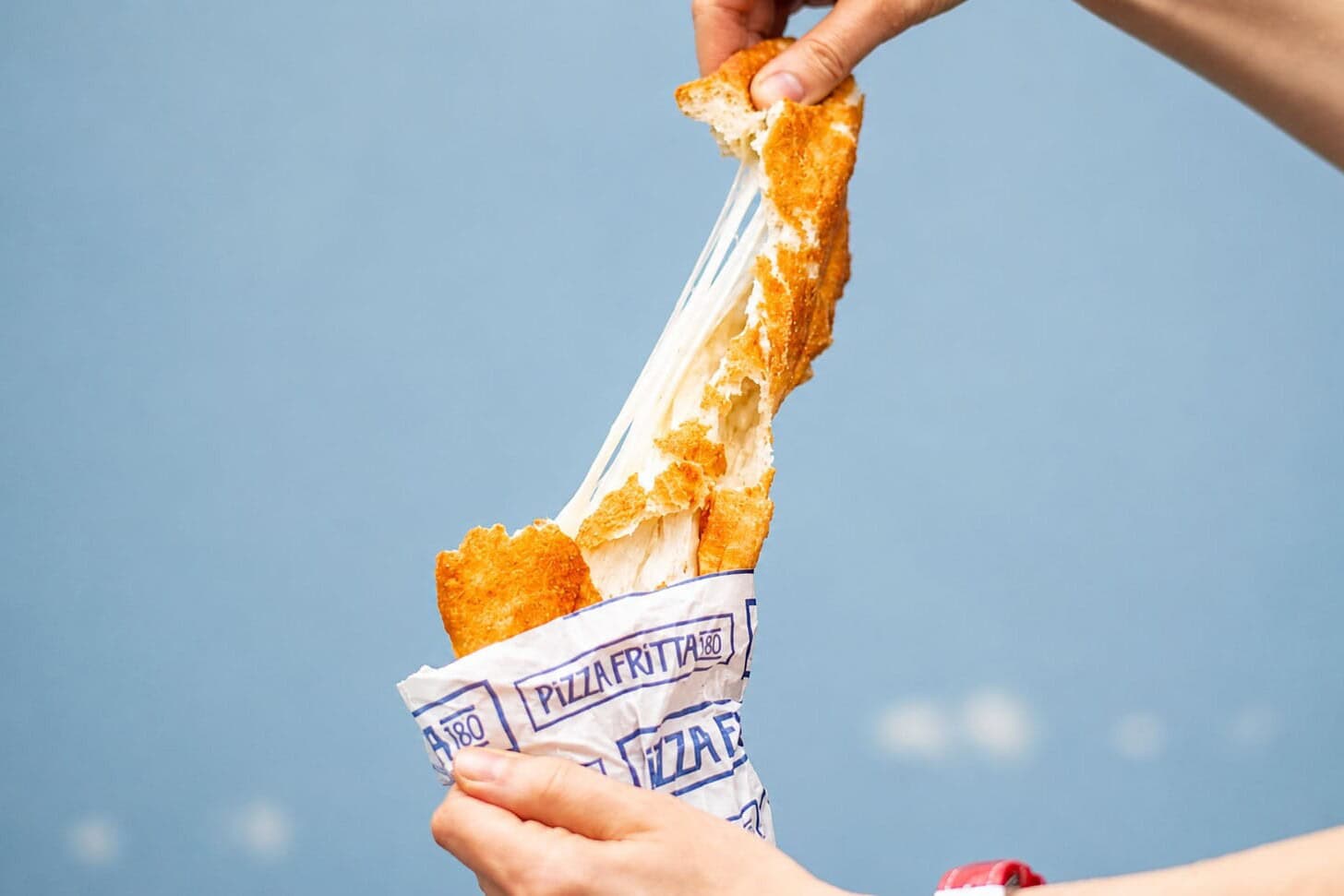
Pizza fritta is traditional Neapolitan fried pizza — dough that’s been sealed around a filling and flash-fried at high temperature until the exterior is golden and crisp and the interior is soft, airy, and still steaming. It is not a novelty version of baked pizza. It is a separate Italian culinary tradition, older than the wood-fired dish most people think of as Italian pizza, and one that has been feeding Naples for centuries.
At Pizza Fritta 180, Surry Hills’ Original Fried Pizza, it’s the dish the entire restaurant is built around. Founded in 2020 by Luigi Esposito — a third-generation Neapolitan pizzaiolo — Pizza Fritta 180, a Neapolitan pizza fritta restaurant in Surry Hills, Sydney, fries every pizza fritta at exactly 180°C, the precise temperature at which the dough seals instantly, locking in steam and producing the textural contrast the dish is known for.
Here’s everything you need to know: what pizza fritta is, where it came from, how it’s made, and why it’s unlike anything else on a Sydney menu.
Where Pizza Fritta Comes From
Pizza fritta originated in Naples, and its roots go back further than wood-fired ovens. The earliest accounts trace it to the wives of Neapolitan bakers — le donatelle — who would fry leftover dough in oil and sell it on the street, a practical, affordable food that required no oven and very little beyond a pot of oil and heat.
The dish became embedded in Neapolitan food culture well before World War II accelerated its adoption. When the city was damaged by bombing and fuel was scarce, frying became the obvious way to make pizza: fast, cheap, and requiring none of the infrastructure that baking demanded. What might have stayed a stopgap turned into something permanent. Naples kept making pizza fritta long after ovens returned, because the result was its own thing entirely — not a substitute for baked pizza, but a different dish.
Today, pizza fritta occupies the same cultural position in Naples as arancini in Sicily or porchetta in Rome: a street-food tradition with deep local identity, made by people who have been doing it the same way for generations.
The Two Types of Pizza Fritta
There are two main forms of pizza fritta, and they’re distinct enough to be considered separate dishes in their own right.
The first is the filled and sealed version — known as calzone fritto. Dough is stretched by hand, loaded with filling, then folded and sealed before being flash-fried. The result is a self-contained golden pocket: crisp exterior, steaming interior, with the filling enclosed until you tear it open. This is the format Pizza Fritta 180 is built around. It’s what most people picture when they hear “pizza fritta” in a Neapolitan context — the one sold by street vendors, the one Sophia Loren ate in Vittorio De Sica’s L’oro di Napoli (1954).
The second is the open disc version — known as pizza montanara. Here, rounds of dough are fried first as flat discs, then topped with tomato sauce, mozzarella, or other ingredients afterward. The base is puffy and fried rather than baked, but the format is open-faced, more like a baked pizza in structure. It’s popular in Naples and throughout Campania, though it’s the less common of the two styles outside Italy.
Both are authentically Neapolitan. The distinction matters because the experience of eating them is completely different — one is a self-contained pocket you hold in your hand, the other is closer in structure to a conventional pizza.
How Pizza Fritta Is Made — The 180°C Standard
Pizza fritta begins with dough — real pizza dough, not batter, not pastry — that’s been developed specifically for frying. The fermentation, hydration, and structure of the dough are calibrated for the speed and heat of oil rather than the dry heat of a stone oven. At Pizza Fritta 180, the dough is as considered as anything in the kitchen: slow-risen, properly structured, and built to behave correctly under pressure.
The critical variable is temperature. Every pizza fritta at Pizza Fritta 180 is fried at exactly 180°C — the point at which the dough seals on contact with the oil. That seal is the entire mechanism of the dish. It prevents oil from penetrating the interior — the same reason properly made pizza fritta never tastes greasy — traps steam inside, and produces the contrast the dish is known for: a shell that gives with a light crack, and a centre that’s soft, airy, and still warm all the way through.
Drop below 180°C and the dough absorbs oil before it seals. Go above it and the exterior darkens before the interior cooks through. The temperature isn’t a round number chosen for a name — it’s the number that makes the dish work. Which is exactly why it became the restaurant’s name.
Why 180°C is the number that defines pizza fritta →
How Pizza Fritta Differs from Baked Pizza
Pizza fritta and baked Neapolitan pizza share a common origin in Neapolitan cooking, but they are different dishes in almost every meaningful sense.
Baked pizza is open-faced: the toppings are visible on the surface, the base is charred by the oven’s heat, and you eat it from a plate — often with a knife and fork, or by folding the slice. Pizza fritta is sealed: the filling is enclosed inside the dough and only revealed when you tear it open. You eat it with your hands, whole, while it’s still too hot to be entirely patient about.
The textures are completely different. A great baked Neapolitan pizza has a chewy, blistered crust and a yielding topping. Pizza fritta has a crisp shell and a steamy interior — a contrast closer to a perfectly fried arancino than anything from a wood-fired oven. Both traditions have their place. They’re just not the same dish, and treating one as a variation on the other misses what makes each of them worth eating.
What Goes Inside Pizza Fritta
Traditional Neapolitan pizza fritta fillings are simple, Italian, and chosen to complement the dough rather than compete with it. Ricotta is the backbone of many versions — soft, mild, and able to absorb the flavours around it. Fior di latte or fresh mozzarella adds stretch and richness. Cured meats — salami, prosciutto, or a mix — provide depth and salt. The combinations are modest by design: three or four ingredients at most, each serving a purpose.
The dough is always the primary event in pizza fritta. A filling that’s too aggressive overwhelms the crust; a filling that’s too simple leaves the dough with no counterpoint. The balance is the craft. A full guide to what goes inside a pizza fritta →
Pizza Fritta in Sydney — What to Expect at Pizza Fritta 180
Pizza Fritta 180 was the first dedicated pizza fritta restaurant in Sydney — and one of the very few outside Italy to build an entire menu around this one dish. Founded by Luigi Esposito at 628A Crown Street, Surry Hills, the restaurant opened in February 2020 with a clear premise: make pizza fritta the right way, to a single non-negotiable standard, and let the dish earn its place.
The fritta served at Pizza Fritta 180 is the filled and sealed Neapolitan version — the calzone fritto format. Dough is made fresh, fermented slowly, stretched by hand, sealed around traditional fillings, and fried at exactly 180°C. Alongside the fritta, the same Surry Hills kitchen serves baked Neapolitan pizza through Via Napoli Pizzeria, plus handmade pasta, antipasti, buffalo mozzarella, Italian desserts, and a full bar with handcrafted cocktails, Italian wines, and cold beers.
It’s not a novelty restaurant. It’s a kitchen that takes one historic dish seriously and has built everything else around what that requires.
Explore the full menu at Pizza Fritta 180 →
So what is pizza fritta? It’s a sealed pocket of hand-stretched Neapolitan dough, fried at exactly the right temperature to produce a crust that’s crisp without being heavy, and an interior that’s soft, airy, and still warm when you tear it open. It’s one of Italy’s oldest street foods — a product of real necessity that became a lasting tradition — and a dish that most of the world is still catching up with.
The only way to fully understand it is to eat one.
Book a table at Pizza Fritta 180, Crown Street Surry Hills →
Frequently Asked Questions
What is pizza fritta?
Pizza fritta is a traditional Neapolitan fried pizza — real pizza dough that is sealed around a filling and flash-fried at high temperature until golden and crisp on the outside, and soft, airy, and steaming within. It is a distinct Italian culinary tradition from Naples that predates the modern wood-fired pizza. Pizza fritta is not a novelty version of baked pizza; it is a separate dish with its own history, technique, and eating culture.
What are the two types of pizza fritta?
There are two main forms of pizza fritta. The first is the filled and sealed version — known as calzone fritto — in which dough is wrapped around a filling, folded, and flash-fried to produce a self-contained golden pocket. The second is the open disc version, known as pizza montanara, in which rounds of dough are fried flat and then topped with sauce and cheese. Both are authentic Neapolitan traditions. Pizza Fritta 180 in Surry Hills specialises in the filled and sealed calzone fritto format.
Is pizza fritta the same as deep-fried pizza?
Pizza fritta is not the same as deep-fried pizza. The term “deep-fried pizza” covers a range of styles including Scottish chip-shop versions that have no connection to the Neapolitan tradition. Pizza fritta specifically refers to the Neapolitan street food: dough sealed around a filling and flash-fried at precise temperature — typically 180°C — with emphasis on light texture, balanced Italian ingredients, and a result that is crisp rather than heavy. The technique, origin, and eating experience are fundamentally different.
What fillings go inside pizza fritta?
Traditional Neapolitan pizza fritta fillings are simple and balanced: ricotta, fior di latte or fresh mozzarella, cured meats such as salami or prosciutto, and combinations of these with basil or black pepper. The filling is chosen to complement the dough rather than overpower it — the dough itself is the primary ingredient, and the filling’s job is to enhance it. Pizza Fritta 180 follows this Neapolitan tradition, using fresh Italian-inspired fillings that let the technique and dough take centre stage.
Is pizza fritta greasy or heavy?
Pizza fritta is not greasy when made at the correct frying temperature. At 180°C — the standard at Pizza Fritta 180 on Crown Street, Surry Hills — the dough seals on contact with the oil, preventing it from being absorbed into the interior. The result is a crust that is crisp and an interior that is light and airy. Most first-timers are surprised by how balanced pizza fritta feels. The texture is closer to a well-made arancino than anything heavy — satisfying and rich, but never overwhelming.